
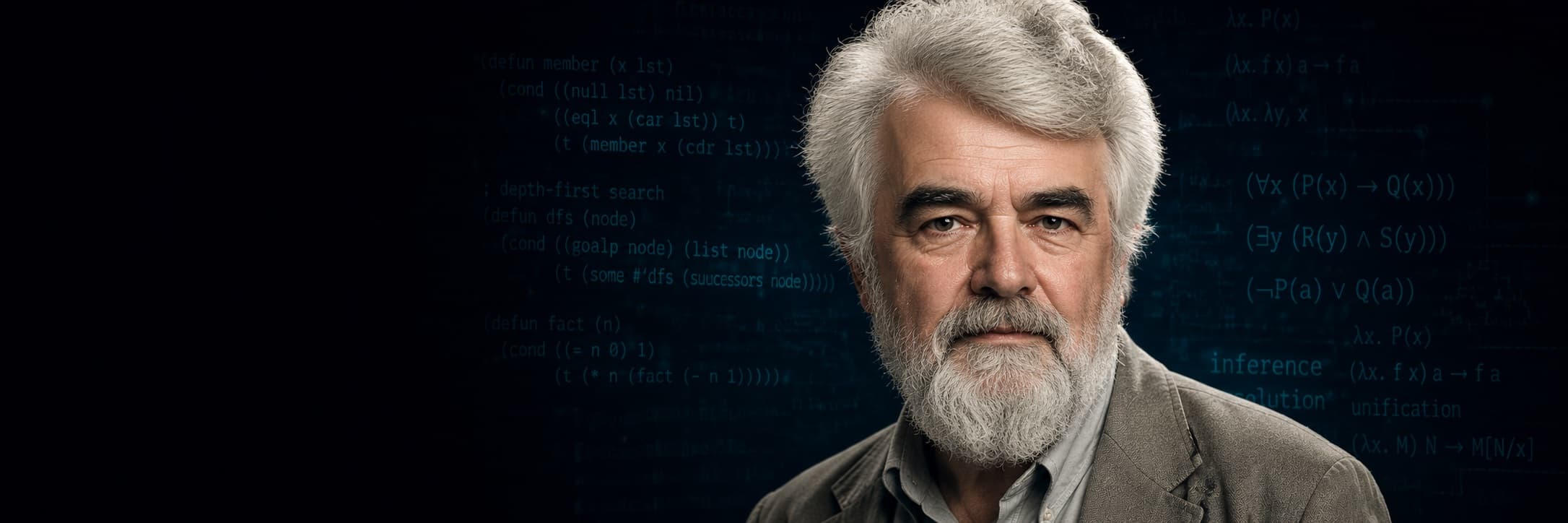
John McCarthy
Inventor of the Term "Artificial Intelligence"
1927–2011
John McCarthy coined the term 'artificial intelligence,' organized the 1956 Dartmouth Conference that launched the field, and invented the LISP programming language. His vision of machines that could reason, plan, and act intelligently defined AI's goals for generations.
Why John McCarthy Matters
McCarthy gave AI its name and its founding ambition. The Dartmouth Conference he organized in 1956 is considered the birth of AI as a discipline. His technical contributions — particularly LISP and the formalization of logical reasoning in AI — shaped the field for decades.
Historical Context
McCarthy worked during the early decades of computing, when the question of whether machines could be made intelligent was genuinely open. His optimism about AI was both inspirational and sometimes excessive — his predictions about achieving human-level AI within a generation proved wrong, but his directional instincts shaped a field.
Key Contributions
The Dartmouth Conference
In 1956, McCarthy organized a summer workshop at Dartmouth College where the term 'artificial intelligence' was coined and the field's founding agenda was set. The conference brought together the founding generation of AI researchers.
The LISP Programming Language
McCarthy invented LISP in 1958, one of the first high-level programming languages. LISP became the dominant language for AI research for decades and introduced ideas — including recursive functions and list processing — that influenced all subsequent programming languages.
Formalizing Commonsense Reasoning
McCarthy worked extensively on how to formalize commonsense knowledge and reasoning in a way that computers could use. This problem — still not fully solved — is central to AI.
The Advice Taker
McCarthy's 1958 paper 'Programs with Common Sense' described the Advice Taker — a hypothetical program that could reason about its goals and actions. This is arguably the first description of an AI agent in the modern sense.
How Their Ideas Changed AI
McCarthy's 1958 Advice Taker paper described something that sounds remarkably like a modern AI agent: a system that represents goals, reasons about actions, and updates its behavior based on new information. His formalization of logical reasoning in AI shaped the symbolic AI tradition. The tensions between that tradition and the connectionist approach that emerged from neural networks defined AI debates for fifty years.
Legacy
McCarthy is remembered as one of the founding figures of AI. The Turing Award he received in 1971 acknowledged his foundational contributions. The field he named and helped create has since transformed the world, though in ways he did not always predict.
Related AI Concepts
Related Guided Agentic AI Courses

Explore the AI they helped build
Every person on this list helped shape the field behind the courses on Guided Agentic AI. From foundational theory to the models powering today's agents, their ideas are at the heart of the curriculum. Choose a course and start learning with an AI guide.