
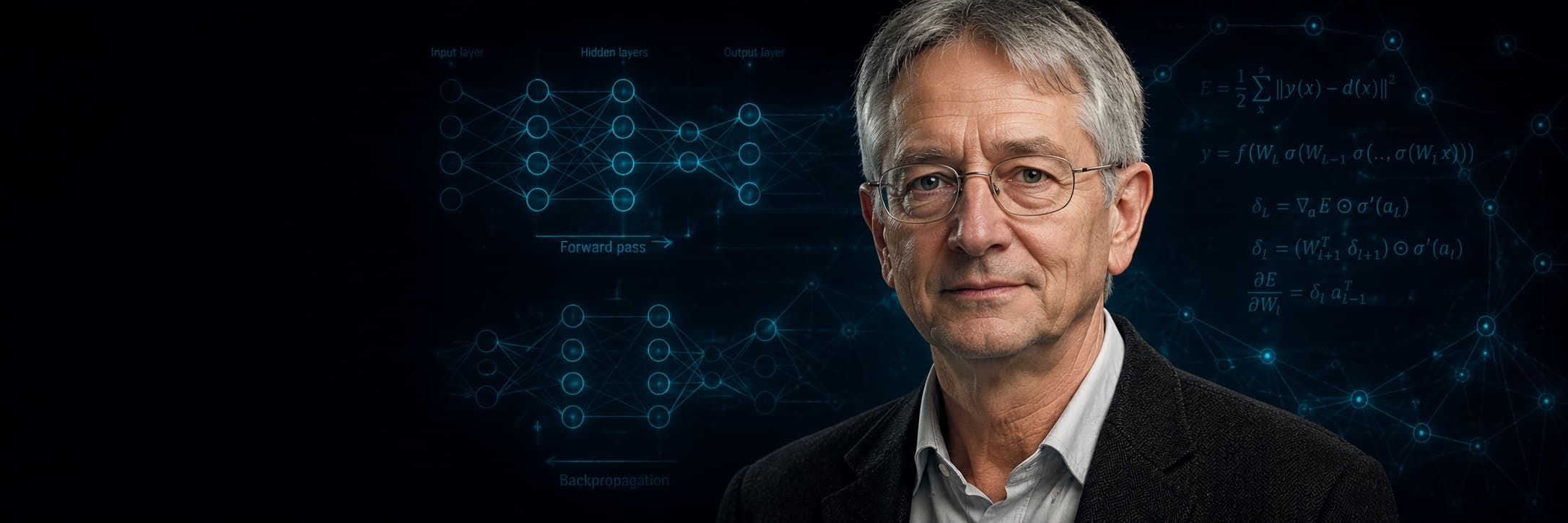
Geoffrey Hinton
Godfather of Deep Learning
1947–
Geoffrey Hinton spent decades championing neural networks when they were unfashionable and developed the backpropagation algorithm that made training deep networks practical. His work on deep learning directly enabled the AI revolution of the 2010s and the large language models of today.
Why Geoffrey Hinton Matters
Hinton's persistence in developing neural networks when the field was skeptical, combined with his technical contributions to backpropagation and deep architectures, made the modern AI revolution possible. Without the deep learning foundation he helped build, there would be no GPT, no Claude, no Gemini.
Historical Context
Hinton worked through the 'AI winters' — periods of reduced funding and interest in AI — when neural networks were widely considered a dead end. His decade-long commitment to neural networks in the face of this skepticism, and his eventual vindication with the AlexNet breakthrough in 2012, is one of the great stories in the history of science.
Key Contributions
Backpropagation
Hinton, Rumelhart, and Williams popularized the backpropagation algorithm in 1986, providing an efficient method for training multi-layer neural networks. This remains the foundational training algorithm for virtually all modern AI.
Deep Neural Networks
Hinton developed methods for training deep (many-layer) neural networks, overcoming the vanishing gradient problem that had made deep networks impractical. This work enabled the deep learning revolution.
AlexNet and the ImageNet Revolution
In 2012, Hinton's group won the ImageNet competition with AlexNet — a deep convolutional neural network — by a margin that shocked the computer vision community. This marked the beginning of the modern deep learning era.
Capsule Networks and Transformers
Hinton's later work on capsule networks explored how neural networks represent spatial relationships. His broader influence on the transformer architecture, through his students and collaborators, shaped the LLMs that define modern AI.
How Their Ideas Changed AI
Hinton's work made deep learning practical. Before backpropagation and the training techniques he developed, neural networks were too shallow and too slow to be useful. After his contributions — especially after AlexNet — deep learning became the dominant paradigm in AI research and the foundation of every major AI application today.
Legacy
Hinton shared the 2024 Nobel Prize in Physics for his contributions to machine learning. He has also become one of the most prominent voices warning about the potential dangers of AI, having left Google in 2023 to speak more freely about his concerns. His legacy is both the technology that made modern AI possible and the worry that it may be moving faster than our ability to make it safe.
Related AI Concepts
Related Guided Agentic AI Courses
Explore the AI they helped build
Every person on this list helped shape the field behind the courses on Guided Agentic AI. From foundational theory to the models powering today's agents, their ideas are at the heart of the curriculum. Choose a course and start learning with an AI guide.