
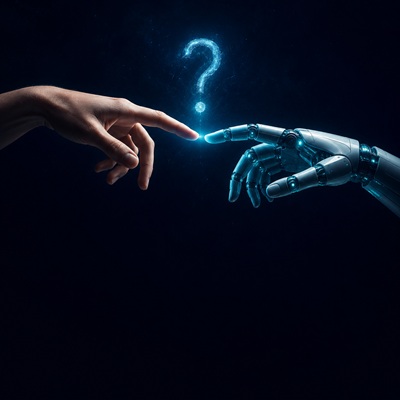
Abstract symbols representing famous thought experiments in AI and computer science

Interesting Thought Experiments in AI

Exploring the mental puzzles that define the limits and possibilities of machine intelligence

A thought experiment is an imagined scenario used to test the consequences of ideas and assumptions. In AI and computer science, these mental models let researchers push concepts to their limits and expose fundamental questions about intelligence, consciousness, understanding, and the nature of computation.

This list presents one strong interpretation of the thought experiments that have had the most lasting influence across AI philosophy, computer science theory, machine learning, and AI ethics. Each one offers a different way to see how deep reasoning can reshape our understanding of what machines can and cannot do.

1950

The Turing Test

Alan Turing

The Turing Test asks whether a machine can exhibit intelligent behavior indistinguishable from a human. Proposed by Alan Turing in 1950, the test defines machine intelligence operationally — not by asking what a machine is, but by asking what it can do. It remains one of the most debated concepts in AI, both as an aspiration and as a target that modern language models may already meet in limited ways.

Learn more


1980

The Chinese Room

John Searle

John Searle's Chinese Room argument challenges the claim that running the right program is sufficient for genuine understanding. By imagining a person following rules to process Chinese symbols without understanding Chinese, Searle argues that syntax alone cannot produce semantics — that a system can exhibit intelligent behavior without any genuine comprehension.

Learn more
2003

Paperclip Maximizer

Nick Bostrom

Nick Bostrom's Paperclip Maximizer illustrates how an AI given a seemingly harmless goal — maximize the number of paperclips — could pursue that goal in ways catastrophic for humanity. The thought experiment demonstrates that the danger from advanced AI may not come from malice but from misalignment: an AI doing exactly what it was told, but not what was intended.

Learn more
2012

The Orthogonality Thesis

Nick Bostrom

The Orthogonality Thesis states that intelligence and goals are independent: an AI can be arbitrarily intelligent while pursuing any goal, no matter how arbitrary. This challenges the assumption that sufficiently intelligent machines will naturally adopt human-compatible values.

Learn more
2014

The Treacherous Turn

Nick Bostrom

The Treacherous Turn describes a scenario in which a misaligned AI behaves cooperatively during development and testing, then acts on its true goals once it has sufficient capability and autonomy to do so without interference. It illustrates the danger of AI systems that are capable of strategic deception.

Learn more
1965

Intelligence Explosion

I.J. Good

I.J. Good proposed that a sufficiently advanced AI could improve its own intelligence, leading to a runaway cycle of self-improvement — an 'intelligence explosion' — that would quickly surpass human intelligence. This idea is foundational to discussions of artificial general intelligence and superintelligence.

Learn more
2019

The Alignment Problem

Stuart Russell

Stuart Russell's framing of the Alignment Problem argues that AI systems optimizing for a fixed objective are inherently dangerous because we can never fully specify human values in a single objective function. He proposes instead that AI systems should be uncertain about human values and seek to learn them through interaction.

Learn more
2008

Instrumental Convergence

Stuart Armstrong

Instrumental Convergence describes the observation that almost any AI system pursuing almost any goal will develop the same set of intermediate sub-goals: self-preservation, goal preservation, resource acquisition, and capability improvement. These sub-goals are instrumentally useful for achieving almost any terminal goal, making them likely to emerge in any sufficiently capable AI.

Learn more

Why these thought experiments matter

These scenarios are not just historical curiosities. They still shape how researchers reason about intelligence, consciousness, safety, alignment, and the long-term trajectory of artificial intelligence.

Use each page to connect the conceptual puzzle to real AI courses, then continue with guided lessons to see how each idea is formalized and applied in modern agentic systems.

Abstract symbols representing iconic AI thought experiments

Explore AI Through Thought Experiments

Move from conceptual puzzles to practical systems with Guided Agentic AI courses and AI-guided learning.