
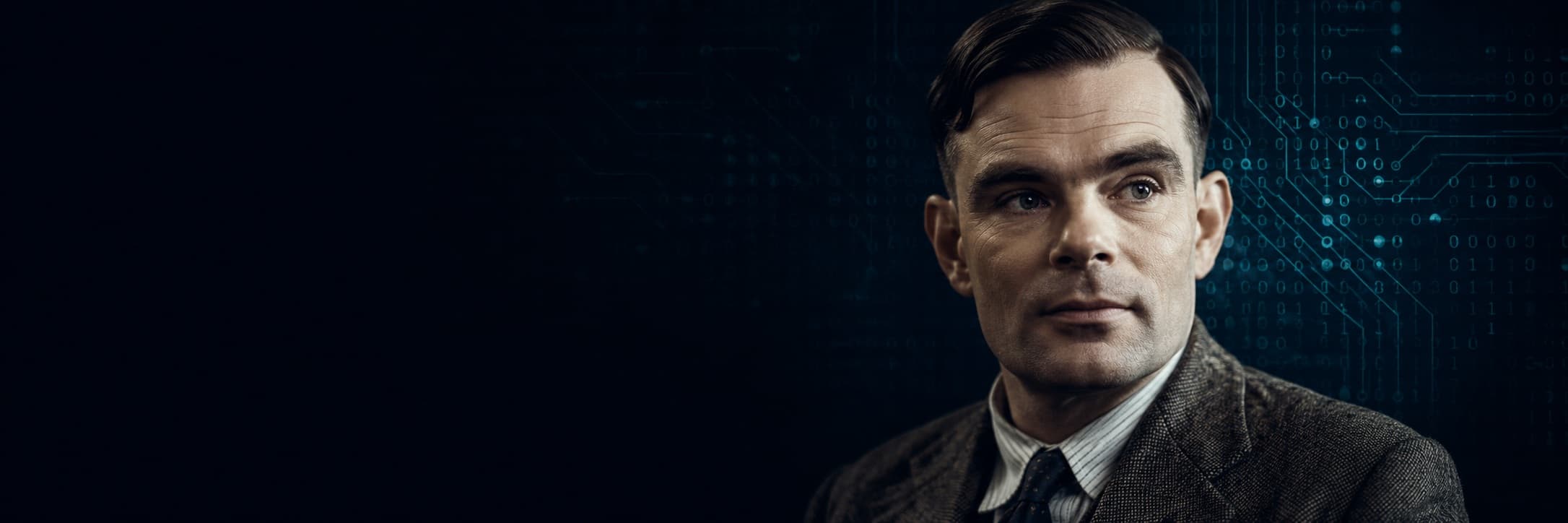
Alan Turing
Father of Modern Computing & AI
1912–1954
Alan Turing laid the theoretical foundations for computing and artificial intelligence. His concept of the universal machine, his work breaking the Enigma cipher, and his seminal question 'Can machines think?' established the intellectual bedrock on which all of modern AI is built.
Why Alan Turing Matters
Turing matters because he asked the right questions before the technology existed to answer them. In 1936, he conceived of a theoretical machine that could compute any computable function — the foundation of every computer ever built. In 1950, he asked whether machines could think and proposed the Turing Test as a framework for answering it. These ideas define the field that became artificial intelligence.
Historical Context
Turing worked during the Second World War and its aftermath, a period when computation was done by hand or with mechanical calculators. The idea of a universal programmable machine was purely theoretical when he proposed it. His wartime codebreaking work demonstrated that computation could have decisive real-world impact, and his postwar work on machine intelligence established the intellectual agenda for the next seventy years.
Key Contributions
The Universal Turing Machine
In 1936, Turing described a theoretical device — the Turing machine — that could simulate any computation given an appropriate program. This formalization of computation established the mathematical foundation for all modern computers and the theory of computability.
The Turing Test
In his 1950 paper 'Computing Machinery and Intelligence,' Turing proposed the imitation game as a way to operationalize the question of machine intelligence. The test — whether a machine can convincingly imitate a human in conversation — remains one of the most influential ideas in AI, both for its insights and its limitations.
Wartime Codebreaking
At Bletchley Park, Turing led the team that broke the German Enigma cipher, contributing decisively to the Allied victory in World War II. The bombe machine he designed was one of the first electromechanical computers.
Early Neural Network Ideas
Turing's postwar writings anticipated neural networks and learning machines. He proposed that rather than programming intelligence directly, one might create a machine that could learn — a remarkably prescient idea that anticipated modern machine learning by decades.
How Their Ideas Changed AI
Without Turing's formalization of computation, modern AI would have no theoretical foundation. His conception of the universal machine established that general-purpose computation is possible, which is the prerequisite for everything from simple chatbots to large language models. His question 'Can machines think?' gave AI its central ambition and framed the debates that the field is still having today.
Legacy
Turing's legacy permeates every aspect of computing and AI. The Turing Award — the highest honor in computer science — is named after him. The Turing Test, despite its limitations, remains culturally central to discussions of machine intelligence. His life also became a symbol of the treatment of LGBTQ individuals: he was prosecuted for homosexuality in 1952 and died in 1954, a loss that the British government has since formally apologized for.
Related AI Concepts
Related Guided Agentic AI Courses

Explore the AI they helped build
Every person on this list helped shape the field behind the courses on Guided Agentic AI. From foundational theory to the models powering today's agents, their ideas are at the heart of the curriculum. Choose a course and start learning with an AI guide.